

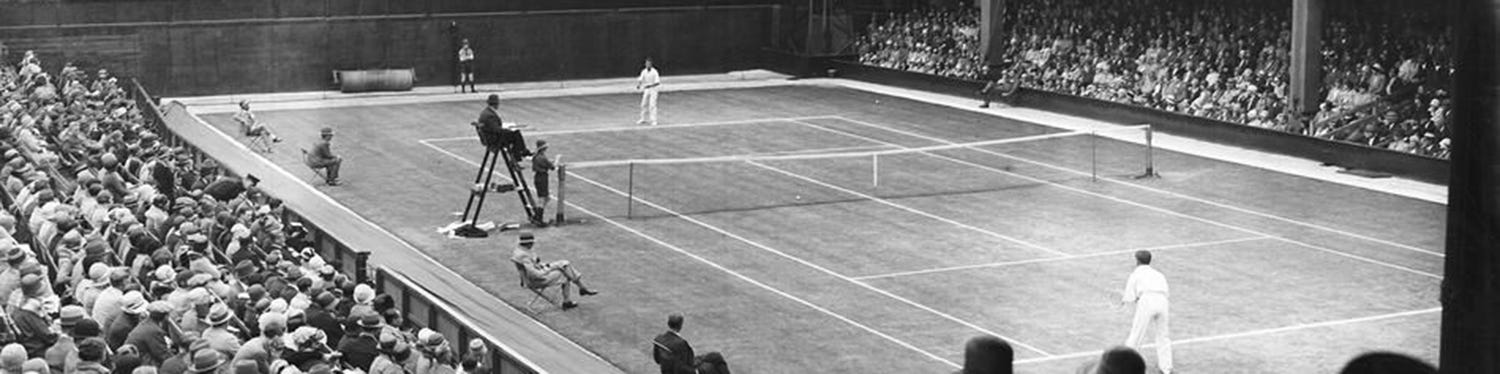
When the Shroud fell, and the dead poured out from behind it, the Borough of Kingswood was safe for a while. As recently as the middle of the last century, people were still living here in their expensive houses, amongst the open commons and parks, pretending that nothing had changed. That their whole way of life had not become immediately and completely ridiculous.
You could still see the evidence of that if you looked close. The buildings were a little less rotten, the streets more easily passed.
Surely, Hemmingway told himself, they must be close to the spot where the photograph was taken, in those last few years before this whole place was abandoned to the geists.
Yes. He followed the street to the top of Whimbrel Hill, and there it was. The common stretching down to the wreck of Kingsroyal Tennis Club. Hemmingway did not even need to look at the photograph again. It was exactly the same view.
He turned to call back: “It’s here! Hurry up!”
By the time Shaw caught up, he was winded and fidgety, glancing around. It was too bright up here. Even behind his glasses, Hemmingway’s eyes ached. Shaw put his hands in his pockets, staring blankly down the hill.
“Are you going to tell me what I’m looking at?”
It was impressive, really. The depth of Shaw’s ignorance. Shaw was not a foolish man. Hemmingway knew that he was not a foolish man. And yet, every so often, the blindingly obvious seemed to evade him.
Hemmingway took out the postcard, and Shaw stared at it for a very long time. Hemmingway shifted. Whoever had killed Cassian Marquez, the answer was waiting for them in that tennis club. He could feel it in his bones.
“Is it really the same place?” Shaw asked at last—at bloody last!
“It was,” Hemmingway corrected. “Once.”
Surely, Hemmingway couldn’t be expected to stand here any longer? He set off downhill and saw, with no small relief, that Shaw followed. All the same, Hemmingway reached the tennis club first and set about trying to find a way in.
He had, if he were being honest, been concerned about this part of their excursion. But in the end, he needn’t have worried. Kingsroyal might only have been abandoned sixty years ago, but it was exposed here, right at the edge of the common. In several places, the outer wall had simply collapsed—roof and walls crumpling inwards, creating a breach through which Hemmingway could easily gain admittance.
Once inside, it was a trifle to find a way down into the players’ rooms. After all, Cook’s History of Tennis in the Harrows devoted an entire chapter to Kingsroyal—how the players ‘entered the centre court through a vast arcade sunk underneath the stands, emerging from the darkness like gladiators to rapturous applause’. It was agonisingly overwrought, but still useful.
Hemmingway stopped at the edge of the arcade, just before it opened up into the stands.
“Over here!” he shouted.
Shaw stopped at Hemmingway’s side and leaned against one of the pillars, looking out into the court. It was overgrown with nothing of note there, no foot trails in the grass, but it provided an excellent view up into the arena. And, if Hemmingway could only find it, the place the Cassian Marquez had visited last Friday night. The same night that he was murdered.
“Shall I serve?” Shaw asked, nodding towards the net.
“Very funny.”
Humour, Hemmingway always thought, was the last resort of the ignorant. He would never understand why Shaw wasted so much of his (not inconsiderable) ability on playing the bloody fool.
“Why are you so certain that Marquez was here?” Shaw asked (a sensible question at last!). “That postcard could have meant anything.”
Slipping his hand into his jacket, Hemmingway ran his thumb over the edge of it—the card peeling and delicate with age. It was printed, as far as Hemmingway could tell, not long after the photograph was taken: the back covered in old-fashioned type, paper foxed and yellowed with age. But the ink on the thing, the writing, that was fresh. A thick black modern ink. Still slightly glossy from the pen. Why go to all that trouble? Why bother to write on such an old card? And why only a single word? “FRIDAY”.
Two possibilities presented themselves. The first was convenience: the card was simply to hand, the only thing that the sender had available. The second was intention. The sender had chosen this card specifically, because it was important.
“Only it didn’t mean just anything,” Hemmingway said. “It meant something very specific. And whatever it was, it got Cassian Marquez killed.”
A meeting, Hemmingway was sure of it. Between Marquez and whoever had murdered him. To arrange such a meeting, the killer needed to communicate two things: a place, and a time. Taken together, the photograph and the word “FRIDAY” gave both.
“Because they found his body on a Saturday?” Shaw asked, finally catching up. “Come on, Tom. There isn’t even a time on the back of that card. An old photograph,” (so, he had noticed,) “and a day of the week does not make for some clandestine meeting.”
There was a thumbprint on the right lens of Hemmingway’s spectacles. He took them off to clean them, and the sunlight roared in, trying to blind him.
“There doesn’t have to be a time, Shaw. Remember what Marquez’s manager said? Cassian followed the same routine every Friday: he went for a run in the morning, then trained at Worple Road until just before dark. There’s only one time he could have done anything.”
But Shaw just shook his head.
“It’s crazy,” he said. “Anyone coming out here after dark is out of their mind.” (Which, Hemmingway had thought, was rather the point.) “The geists would have torn him apart and, unless I’m mistaken, whoever killed Cassian was very much alive. Not to mention that they were back on the other side of the river.”
Hemmingway put his spectacles back on (what blessed relief!) and, almost right away, noticed something he had missed. The wind picked up. Just for a moment, but long enough for something to shift in the upper tiers.
What was that? A sheet or ribbon catching in the breeze? No, it was more substantial than that. And were those colours he could see, beyond the deafening roar of the sun?
“There,” he told Shaw. “What is that?”
It was surely the edge of a blanket—sun-faded and hanging across the mouth of a stairwell. Exactly, in fact, what Hemmingway had been looking for.
“Tom,” Shaw called out as Hemmingway crossed the court. “We should get going. It won’t be long before the sun goes down.”
There were precisely two and a quarter hours before sunset. Hemmingway kept walking. It took him a while to find a way into the upper seating—so many of the stairwells had collapsed or were blocked with rubble. But when he discovered the way, he was able to orient himself swiftly—putting the umpire’s chair to his left and following the curve of the balcony until he found that blanket (that beautiful blanket!) rippling in the rising heart.
This was it. Of course the killer hadn’t chosen this place at random! They had known that Cassian would be here. The wine bottles scattered amongst the cushions came from the same vineyard as the ones in Marquez’s cellar. There was even a pair of tennis shoes. Yes, there was no question. They were so far west that Cassian Marquez should never have been here. That no one would have looked for him.
But the killer had known. They had known, and they had used that knowledge to lure Marquez to his death. Because Hemmingway was increasingly sure he had died here. It was clear from the livor mortis that Marquez had lain somewhere for at least a few hours before someone (perhaps the killer themselves) had (for reasons which were still uncertain) dragged him back across the river to dump it on a practise court at Worple Road.
What was it Doctor de Winter had said when she assessed Cassian’s body?
‘The fog, he can smell it, wet on the long grass. Doubling each blade of it over, weighing it down. He is sinking.’
It had to be here.
Shaw was standing behind him now. How long had he been there?
“This was where Marquez was coming,” Hemmingway said. “His bolthole. And for quite some time, by the look of it. Sleeping here, even.”
“Did it have to be Marquez?” Shaw asked. “It could have been anyone. It could have been the person that killed him.”
Hemmingway snatched one of the tennis shoes off the floor and tossed it to Shaw.
“Do you remember the pair we found in Marquez’s locker?”
Shaw scowled at the shoe for a moment, then held up his hands.
“All right, all right. No need to take my head off with it.”
Hemmingway didn’t smile. That would only encourage him.
“Not my fault that you never learned to catch.”
There should be something else. Some sign of what had happened. It niggled at Hemmingway like a sore tooth.
“Cassian’s manager said that he hadn’t been himself for the last couple of months,” Shaw said. “That he’d seemed distracted. But if he was coming out here regularly, I’d say that Mrs Marquez has a few more questions to answer.”
That was putting it lightly.
“Yes, I should say so.”
They would have to question Claudia Marquez again, but Hemmingway would leave that to Shaw.
Was there really nothing else? Hemmingway had been so certain. Had he deluded himself? Ignored the evidence? No, Marquez must have died here. It was the only answer that made sense of everything: the message on the postcard, Cassian’s strange behaviour, the glimpses Doctor de Winter had gleaned from his body, why there was not a single drop of blood in the grass where he was found...
Perhaps there was some other explanation. Something that Hemmingway had discounted, because he was so damned set on what he thought (what he knew!) to be the truth.
He glanced across at Shaw. Suddenly, Hemmingway felt rather unwell.
“What is it?” Shaw asked.
The answer, Hemmingway realised, was staring him right in the face. He crossed to the edge of the balcony and looked down at the railing.
“Is that blood?” Shaw asked.
It was. It most certainly was! Hemmingway pushed the tapestry aside and stepped into the space beyond.
“There’s more of it.”
He could almost see how it had happened: Marquez stumbling away, clutching at his throat. Unable to stop the bleeding. Hemmingway followed the blotches and smears to their grisly conclusion—to the top of a stairwell, and the thick black stain smothering the concrete where Cassian Marquez had died.
Without thinking, he called back: “Shaw! Over here!”
Only when Shaw turned ashen did Hemmingway realise what he’d done.
Shaw tugged at his gloves, stepping back, but it wouldn’t be enough. Not when Shaw was already so close to Marquez—had spoken to his wife and his friends—and not when the blood of Cassian’s passing was thick under their boots.
Shaw’s face contorted into a horrible mask. He didn’t make a sound, but sucked down a breath and held it, his eyes glazing, rolling back.
Hemmingway caught him before he fell. Shaw hadn’t even wanted to come here, but Hemmingway had dragged him to the site of a massacre—knowing full well how Shaw’s sensitivities would force him to endure every moment of it. That he would feel Marquez’s death as though it were his own. Stupid, stupid mistake. Hemmingway should have known better. He did know better. And yet...
He tightened his grip on Shaw’s arm. Was it over? Yes, some of the colour was coming back into his face.
Shaw leaned into Hemmingway’s hand and nodded vaguely, dripping with sweat. Hemmingway didn’t ask what he’d seen. He didn’t want to know.
“We should head back to the Terminus,” he conceded instead. “Luminous will want to know that we’ve found the place where Cassian Marquez was murdered.”